
Two-tier secret-scan
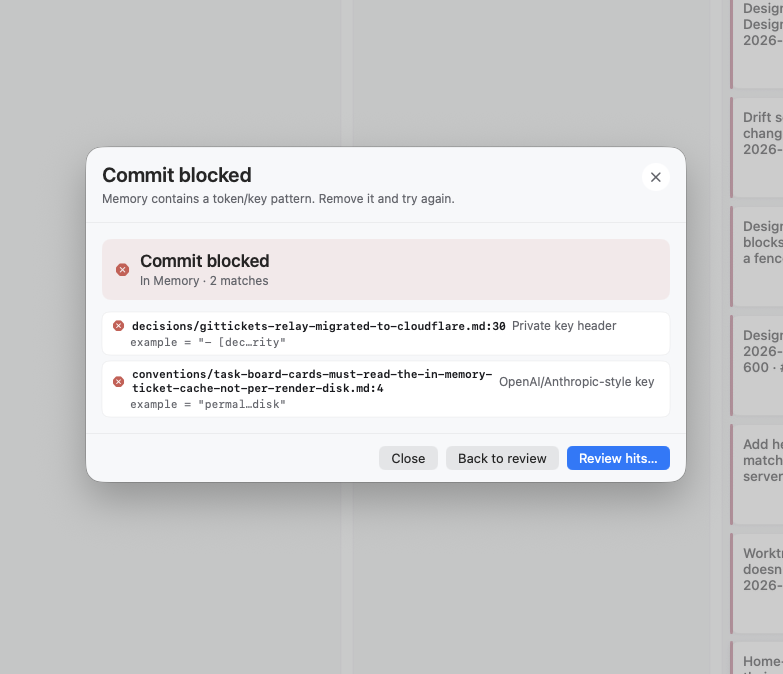
Hard-block patterns stop known token shapes cold; heuristic warnings flag secret-like assignments for a human to confirm. Nothing reaches a published wiki unseen.
Memophant earns trust the boring way: your knowledge is plain files in your own repo, secrets are gated before they're ever published, and the license guarantees the code outlives us.
Hard-block patterns stop known token shapes cold; heuristic warnings flag secret-like assignments for a human to confirm. Nothing reaches a published wiki unseen.
Every secret — your Anthropic API key and each Vendors credential — lives solely in your iCloud Keychain, synced across your own Macs by Apple and never leaving them. Agents read or write a vendor secret only through a one-click approval prompt; the repo holds just a reference.
Memophant is non-sandboxed so it can run git and index your repos. Your memory never leaves your machine without your say-so — the only content sent anywhere goes to Anthropic, and only when you ask. (The app checks for updates and license status separately; neither sends your memory.)
Secret-scan
Every commit and publish runs the scan. Hard hits block outright; soft hits surface the exact file and line so you can confirm a false positive — publishing is permanent, so it's deliberate.
Vendor credentials
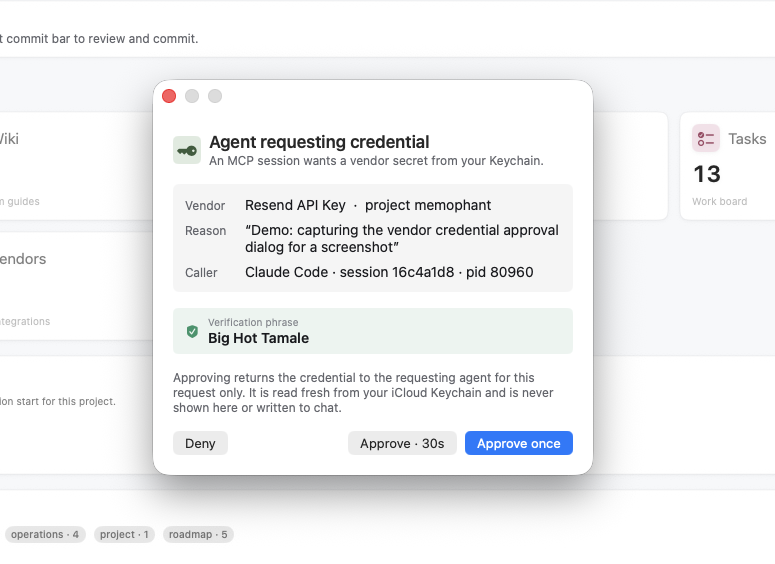
Memophant gives agents two MCP tools: get_vendor_credential to fetch a secret, and set_vendor_credential to store one they just minted (a fresh API key, a wrangler token). Every call surfaces a native approval prompt — nothing is read or written without your click — and a verification phrase you set marks the real dialog so a look-alike can't fool you.
Data ownership
No lock-in is the point. If you stopped using Memophant tomorrow, every byte of your memory would still be sitting in your repo.
Every note, page, and task is a file you can read in any editor. No proprietary database, nothing to export.
Search and indexing run on Memophant's own memory engine — patterned after the best open-source memory platforms, with no external CLI to install. The files still work in any editor without it.
The app stores only a thin projection for the UI. Your memory is versioned, diffable, and reviewable in normal pull requests.
The Heirloom License
While the developer is active, Memophant is a normal paid product. But if it's ever truly abandoned, the source is released under MPL-2.0 — automatically, irrevocably, for everyone, forever. The trigger is mechanical: a single commit, release, or signed heartbeat resets the clock.
The plain-English summary is an overview, not a contract — where it differs from LICENSE.md, the license wins.
The calm, native memory layer your security team will actually approve.