
Travels with the code
Memory is committed alongside the work it describes. Clone the repo and you get the decisions, the conventions, and the gotchas — no separate database to provision, no export to chase.
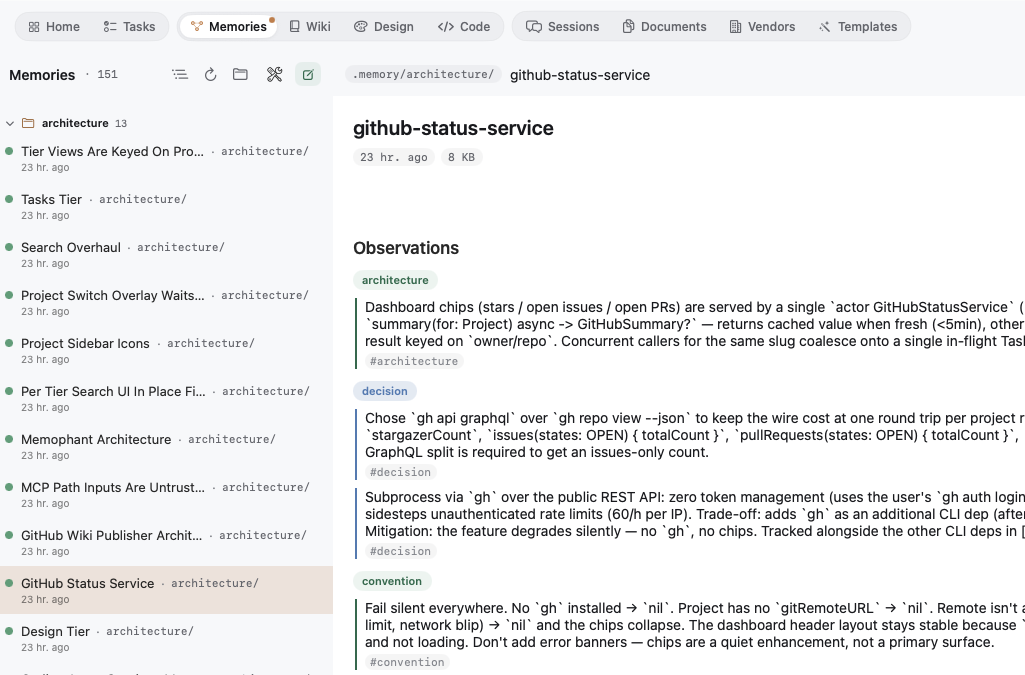
No proprietary database, no cloud to trust, nothing to export. Every note, every relation, every provenance stamp is markdown under .memory/ — versioned with the code it describes and read by every agent that opens the repo.
Memory is committed alongside the work it describes. Clone the repo and you get the decisions, the conventions, and the gotchas — no separate database to provision, no export to chase.
Every note is plain markdown with provenance. It diffs in a pull request, gets commented on, and merges through the same review your team already trusts.
Nothing is locked inside the app. The files work in any editor, the CLI, or another agent — and the Heirloom License opens the source if Memophant is ever abandoned.
The shape of a memory
Each note pairs atomic observations with explicit relations, so facts are searchable and links are something you authored. A note can record the source files and the commit it was reviewed against — which is what makes drift detection possible later.
Built for speed
Memophant used to shell out to basic-memory, a Python tool. On 2026-06-06 a pure-Swift, in-process engine replaced it as the sole backend — hybrid full-text (BM25 over SQLite FTS5) fused with on-device MiniLM embeddings. It runs locally, with nothing to install.
faster than the basic-memory tool it replaced
of benchmark queries returned a relevant hit
queries across 7 real projects, in one run
external processes — a pure in-process Swift engine
Across 250 queries on 7 real projects, the engine returned a result on every one, at a 13–113× speedup. On one head-to-head query it surfaced 20 relevant matches where the old tool found 5 — with the top five identical. Numbers are from Memophant's own benchmarks; your mileage varies with corpus size.
Hybrid search
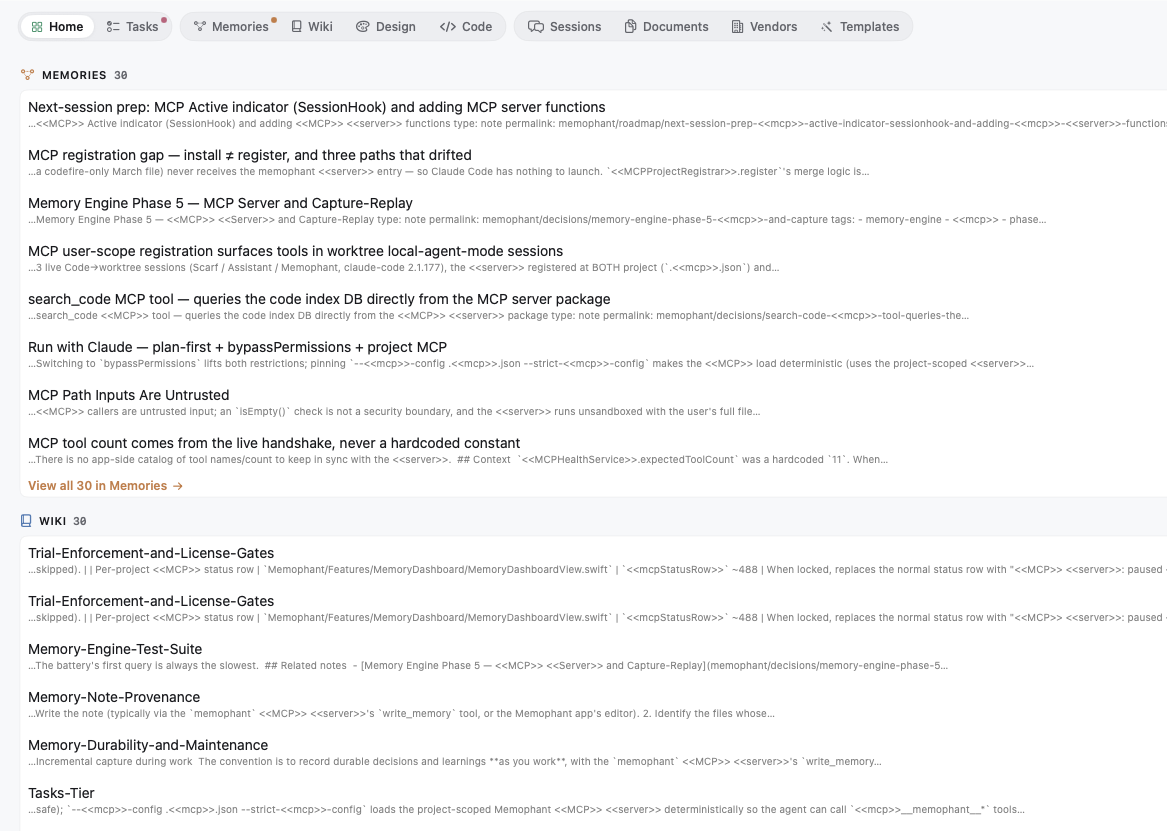
BM25 catches the exact term; the embedding model catches the idea you phrased differently. Memophant fuses both rankings so a typo, a synonym, or a natural-language question all land on the right note — in milliseconds, on your machine.
Your repo becomes the source of truth, and every agent reads from it.